Client notifications & reminders
Reminders cut no-shows more than any other setting in the app. This guide covers the automated emails your clients receive, how to turn on email and text reminders, and the notifications you get as a clinician.
Setting up appointment reminders
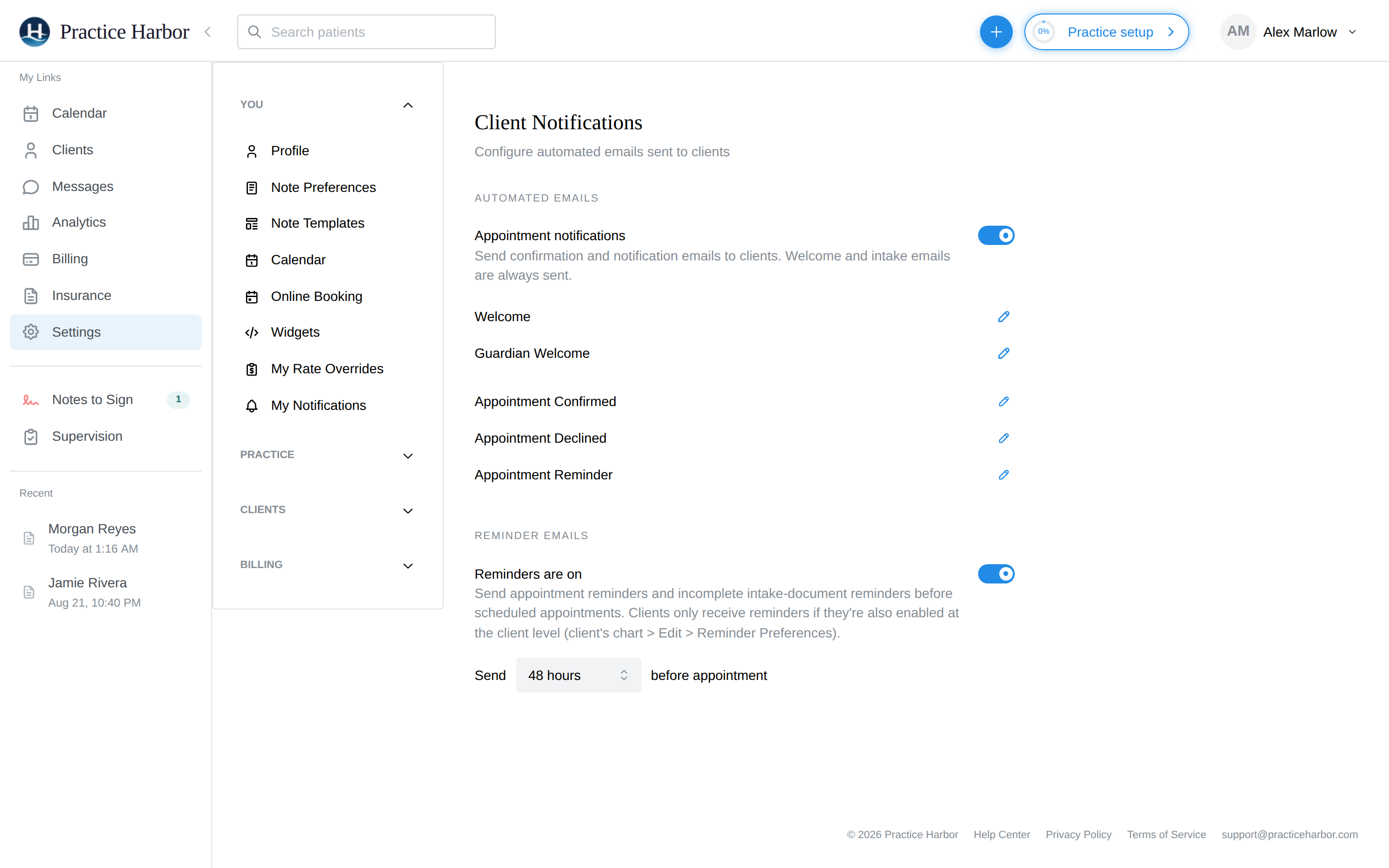
- Go to Settings → Client Notifications (under Clients — practice owners and managers only).
- In Reminder Emails, make sure Reminders are on — it is by default.
- Choose the timing: send 24, 48, or 72 hours before the appointment (48 is the default). Changes save automatically.
That's the practice-wide half. Each client also has their own settings, on by default for email — check them if someone reports missing reminders:
- Open the client's chart and click Edit.
- Under Contact details, make sure the email address is marked Email OK (not Do not use).
- Under Reminder and notification options, confirm Upcoming appointments is on and the Email dropdown shows the address you expect. If the client has several addresses, pick the one that should receive reminders; choose No email to stop email reminders for this client.
Reminder emails include a calendar invite (.ics) the client can add to their own calendar, and for telehealth sessions, the link to join.
When the reminder goes out
Reminders are sent on the hour, not at the exact minute. Each hour, a reminder goes to every client whose appointment is about that far away, so with a 48-hour setting a client booked for Tuesday at 7:40 PM gets theirs on Sunday at 7:00 PM or 8:00 PM. An appointment booked with less notice than your setting has already passed that point and gets no scheduled reminder.
To see which reminders have gone out, open Analytics, then Reports, then Appointment reminders: every reminder sent, with the date and time, the client, email or text, and whether it went (details). The appointment window itself doesn't list them. For a video session you can send one yourself at any time: open the appointment and click Share link next to the video icon, then Send reminder. The client gets the reminder email with the join link right away, and you see a confirmation that it was sent. Use it for a session booked too close to its start for the scheduled reminder, or when a client has lost the email. It follows the same practice and client settings as the scheduled reminder, and you can send it again. See Sharing the join link.
Reminders go only for appointments still on the books — cancel or delete a session and no reminder is sent. For couples, family, and group sessions, every member gets their own reminder. For clients without their own email (a child, say), the reminder goes to the guardian's email instead, and family contacts who've been given appointment access in the portal receive reminders too.
Video session reminders
For appointments at your built-in Video Office, reminder and confirmation emails carry a Join video session button. The button is made for that one client: clicking it signs them in and puts them straight into your waiting room, with no password to find. The link in the calendar attachment opens the portal's join page instead, where they sign in as usual. Appointments at a Doxy, Zoom or other outside link carry that link, exactly as you saved it.
About 10 minutes before each session at your built-in Video Office, every client on it gets a second email, "Your video session starts in 10 minutes", with the same Join button. Contacts you set to receive the client's appointment reminders (a parent, for example) get their own copy. Sessions at a Doxy, Zoom or other outside link don't get this email; their link is already in the regular reminder. It goes out whenever your appointment reminders are on; there is nothing to set up. It is email only; text reminders are unchanged.
If a client opens the Join button on a different device from the one they first used, the link may say it has already been used. They can ask for a fresh sign-in link on that page, or sign in to the portal and choose Join Session.
Customizing the emails clients receive
The Automated Emails section of the same page controls the rest of client email:
- Appointment notifications — confirmation and update emails when you accept or decline a client's online booking request. Welcome and intake emails are always sent regardless — they're functional, not promotional.
- Click the pencil next to any template — Welcome, Appointment Confirmed, Appointment Declined, Appointment Reminder, Guardian Welcome — to rewrite it in your own voice. Insert placeholders (client name, appointment date/time, practice details, portal link) from the macro menu, and they're filled in per email.
- Edit beside a live preview. The pencil opens the template in a panel on the right, with your text on the left and Preview beside it, showing the email the way a client gets it with sample details. Anything in braces that isn't a variable is flagged in orange: an unknown variable is sent blank, and anything else (such as a web address typed inside braces) is sent exactly as typed, braces included.
- Preview for each location. One template serves all your locations. Use Preview for above the preview to see how it reads for an office, your Video Office, or a Zoom or Doxy location.
- Video link in your own reminder. The Appointment Confirmed and Appointment Reminder emails always carry a Join video session button for sessions at your built-in Video Office, and for sessions at a Zoom, Doxy or other video location with a meeting link saved on it. If your text leaves the link out, the button is added under it, and the preview shows where it goes. To put the link somewhere specific instead, add Links → Telehealth Join Link where it should go. A video location with no link saved gets no button; the preview tells you so. Office appointments get nothing in that spot. Don't paste your video address into the template: it would go to office clients too.
Variables for appointment emails
| Variable | What the client sees |
|---|---|
| Appointment → Location | For an office, its address (street, city, state and ZIP). For video or phone, the location's name. |
| Appointment → Telehealth Prefix | "Telehealth" for video and phone appointments, blank for the office. Handy in a subject line. |
| Practice → Address | The address of the office the appointment is at. For video and phone appointments, your practice address. |
| Practice → Map Link | A Google Maps link to that office. Blank for video and phone appointments. |
| Links → Add to Calendar Links | Links to add the appointment to Google Calendar or Outlook. Apple Calendar users can open the invite attached to reminders. |
| Client → First Name's | The client's first name with 's, e.g. "Jordan's appointment". Uses their preferred name when set. |
| Clinician → Email | The email of the clinician on the appointment. |
When a client replies. Reminders and other automated emails are sent from the practice's name at a Practice Harbor address, and a client who hits Reply reaches your Practice Email (set under Practice settings). If you haven't entered one, the reply bounces with a note asking the client to contact you directly, so enter a Practice Email if you want replies. The email you sign in with is never used. A reply is an ordinary email in your inbox, not a message in the client's chart, so a cancellation sent that way still has to be entered on the calendar.
When you schedule an appointment directly, the client does not get a confirmation email — only appointments the client requested (and you approved) trigger one. The reminder email before the session is what tells directly-scheduled clients about it, so pick a reminder window that gives them enough notice.
Reminding clients to finish paperwork
To chase unfinished intake forms automatically, flip the per-client switch: client's chart → Edit → Reminder and notification options → Incomplete documents. It's off by default; when on, the client is emailed before each appointment about any pending forms, consents, or measures. If the client has several email addresses, pick which one these go to — it can differ from the appointment-reminder address. See Intake forms.
Setting up text (SMS) reminders
- Go to Settings → Client Texts.
- Turn on Text appointment reminders and pick the timing — 4, 24, 48, or 72 hours before (default 24).
- Get each client's consent: client's chart → Edit → Contact details → set the phone number's permission to Text / voicemail OK, then under Reminder and notification options pick that number in the Phone (by text) dropdown. Both steps are needed: the permission records that the client agrees to texts at that number, and the dropdown is what turns reminder texts on. Texting is strictly opt-in per number; message and data rates may apply, and every text ends with "Reply STOP to opt out".
What the text says
Reminders lead with your practice's name, so clients recognise who the message is from:
Riverbend Counseling: Reminder of your appointment on Tuesday, June 30 at 2:00 PM CDT. Reply STOP to opt out.
The time is shown in the client's own time zone if they have set one, otherwise your practice's. Unless you have customised it (below), the wording is the same for every practice — only your practice name, the date and the time change.
Customizing the text
Practices with Customize text reminder on the Client Texts page can write their own wording, for example parking directions or the number to call to cancel. It is rolling out practice by practice; if you don't see it yet and would like it, ask support.
- Go to Settings → Client Texts and find Customize text reminder under the reminder switch.
- Edit the message. Click Add information fields to drop in the Appointment date, Appointment time, Practice name or Practice phone (the phone comes from Settings → Practice).
- Watch the preview on the right, then click Save changes. Reset to default brings back the standard wording.
A few rules keep the texts deliverable. Your practice name always comes first and every text ends with "Reply STOP to opt out. via Practice Harbor" — neither can be edited. The message must include the appointment date and time, can't contain links or web addresses, and is capped at 250 characters of your own text. Keep it to logistics: never a diagnosis, a service name or anything else clinical, since texts aren't encrypted. Practices with custom wording send from a different Practice Harbor number than the standard reminders; clients can't reply to either.
Two things worth knowing. The texting number cannot receive replies — if a client texts back, nobody sees it. "STOP" is the exception and always works to unsubscribe. And reminders never contain notes, diagnoses, the service type, or the clinician's name.
Texts aren't encrypted, so reminders carry only your practice name, the date and the time.
Clients agree to texts themselves. The consent they see says texts aren't encrypted, that reminders show your practice's name, and that texts are optional and never a condition of care, so there is nothing extra for you to collect. A client who would rather not receive texts can leave the box unchecked or turn reminders off at any time; email reminders are unaffected.
Your own notifications
What you get emailed about lives at Settings → My Notifications (under You):
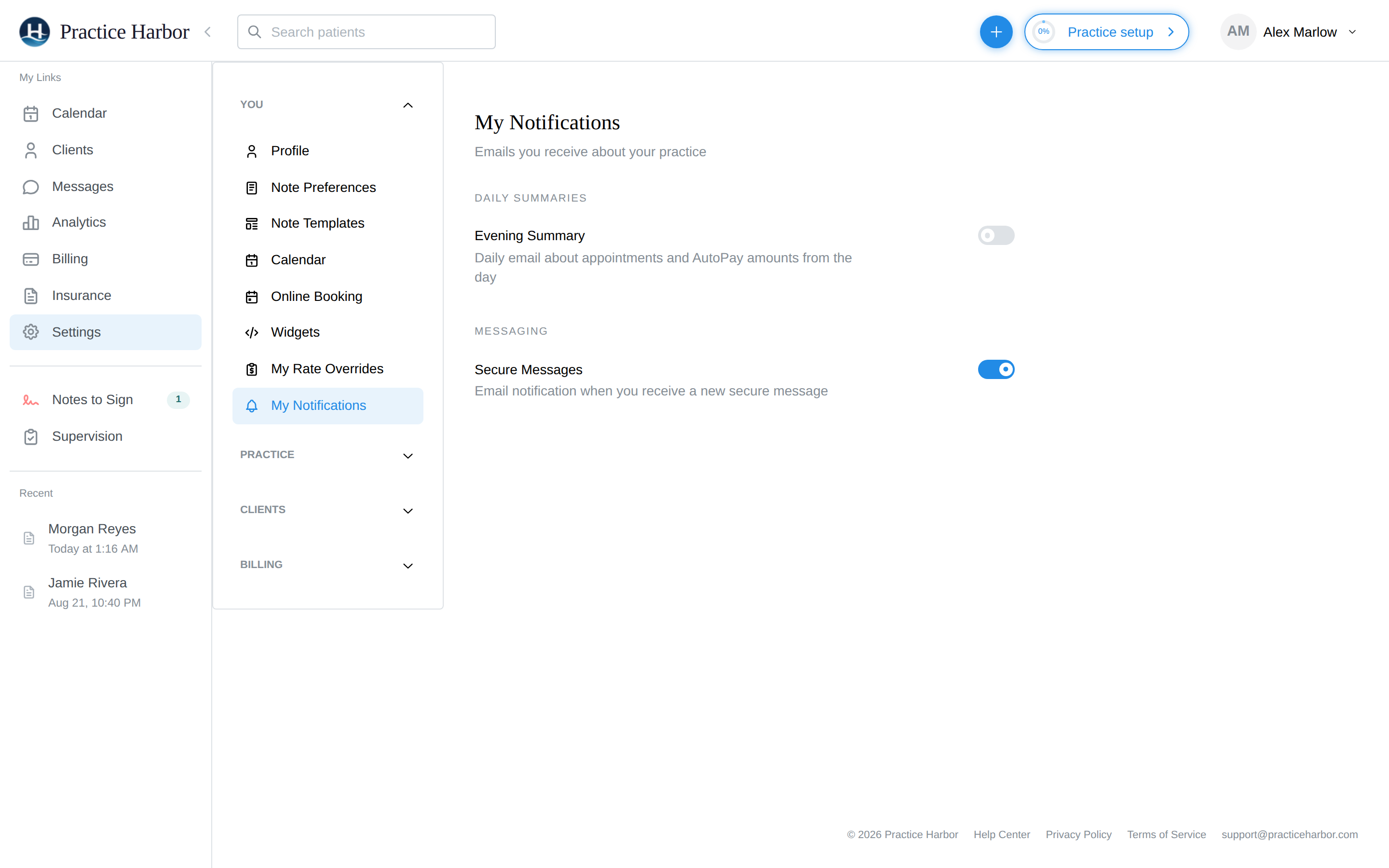
- Evening Summary — a daily digest of the day's appointments and AutoPay amounts (off by default).
- Secure Messages — an email whenever a client sends you a secure message (on by default).
Some practice events email you automatically, no setting needed: a new client request from your booking page, an appointment request from an existing client, a client cancelling a booked appointment from the portal, and a client completing the last of their intake forms.
Telling a client you cancelled
Turn on Alerts under Settings → Calendar (it is off until you do). Then, when you change an appointment to Clinician Cancelled and save, a Send cancellation message? dialog appears. It lists the client, plus any contacts who receive their appointment reminders, with Email and Text pre-ticked from each person's own reminder settings. Anyone with no reminders turned on is listed underneath so you know they will not hear from the app. Click Send cancellation message or Don't send.
- The email uses the Appointment Canceled template under Settings → Client Notifications, which you can edit. The text reads: "The appointment on [date] at [time] has been canceled by [clinician]. No appointment fees will be charged." No client name is included in the text.
- Each message is recorded on the client's activity, so the same cancellation is never sent twice.
- The prompt is practice-wide: turning Alerts off again under Settings → Calendar stops it for everyone.
A plain Cancelled (the client cancelled with notice), Late Cancelled, No Show and a client's own cancellation from the portal never prompt. Cancelling a group session asks which of the two it is.
Troubleshooting
A client says they get no reminders. Check in order: Reminders are on at Settings → Client Notifications; the client's own Upcoming appointments setting and its Email dropdown (chart → Edit → Reminder and notification options); the address is marked Email OK under Contact details; and the appointment is still booked — cancelled sessions don't remind.
I booked a test appointment and no reminder came. Reminders go out on the hour, and only for appointments about as far away as your timing setting — see When the reminder goes out. To see whether it was sent, open Analytics, then Reports, then Appointment reminders. For a video session you can send one now: open the appointment, click Share link next to the video icon, then Send reminder.
Can I send a reminder right before a session? Yes, for a video session. Open the appointment, click Share link next to the video icon, then Send reminder. The client gets the email with the join link right away.
Can I skip the reminder for one specific appointment? No — reminders switch at the practice or client level only. If a session shouldn't be reminded about, it usually shouldn't be on the calendar as booked.
Why did a client get no confirmation when I booked them? By design — see the note above. Their reminder email will still arrive before the session.